Phase-field primer for mechanics engineers
This document is a compact review for engineers who already know
finite elements, linear elasticity, and small-strain plasticity, but
have not used phase-field fracture before. It explains why the model
in phast looks the way it does and points to the public references at
the end of this page.
Variational fracture in one minute
Griffith’s 1921 fracture criterion balances elastic strain energy
against a surface energy proportional to the crack area. Francfort and
Marigo (1998) recast the criterion as a global energy minimisation:
find a displacement field u and a crack set Gamma minimising
where \(\psi\) is the elastic strain energy density, \(G_c\) is the critical energy release rate, and \(\mathcal{H}^{n-1}\) measures the \((n-1)\)-dimensional crack surface.
The discrete-crack-set problem is intractable on a fixed mesh. Bourdin,
Francfort and Marigo (2000) proposed a regularised form that
approximates the sharp crack \(\Gamma\) by a smooth scalar damage field
\(d \in [0, 1]\) with a length scale \(\ell_0\). As \(\ell_0 \to 0\) the regularised
energy gamma-converges to the sharp-crack energy. In phast
the regularised energy is
\(g_\eta(d) = (1-\eta)(1-d)^2 + \eta\) is the standard degradation function; \(w(d)\) is the local dissipation density; \(c_w\) is a normalisation constant. The normalization above gives \(c_w=1/2\) for AT2 and \(c_w=2/3\) for AT1. The displayed functional describes the standard split model before external work is subtracted. PhAST treats the small residual stiffness as a mechanics regularization; its conventional linear AT1/AT2 damage operator retains the \(\eta\)-independent driving coefficients. Other degradation families have separate capability boundaries and should not be inferred from this equation.
With this convention, the AT1 weak form uses \(3G_c\ell_0/4\) for the gradient term and \(2\mathcal{H}-3G_c/(8\ell_0)\) for the damage source. Thus the corresponding zero-damage threshold is \(\mathcal{H}_{c,0}=3G_c/(16\ell_0)\); these are two forms of the same normalization, not separate AT1 constants.
AT1 vs AT2
The two standard regularisations differ in w(d) and c_w:
Model |
|
|
Elastic threshold |
Reference |
|---|---|---|---|---|
AT2 |
\(d^2\) |
\(1/2\) |
None; damage may start at nonzero strain |
Bourdin et al. (2011) |
AT1 |
\(d\) |
\(2/3\) |
\(\mathcal{H}_{c,0}=3G_c/(16\ell_0)\) |
Pham, Marigo, Maurini (2011) |
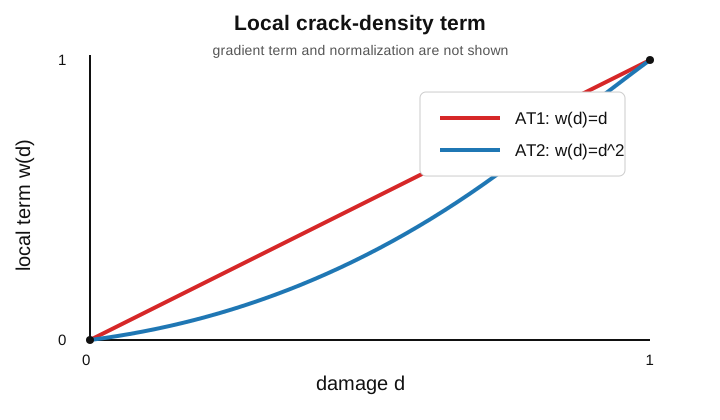
AT1 and AT2 differ through the local term \(w(d)\). The full crack-surface density also includes the gradient penalty and the normalization constant \(c_w\), so this plot should not be read as a complete fracture-energy density or as the one-dimensional crack profile.
AT2 is mathematically simpler – the damage equation is linear in \(d\) for fixed history field \(\mathcal{H}\), so a single CG solve does the job. The downside: at any non-zero strain a tiny amount of damage develops everywhere, because there is no elastic threshold. Most papers therefore enforce a post-hoc nucleation threshold or a pre-existing notch.
AT1 has a true elastic phase: damage stays at zero until the local
driving energy \(\mathcal{H}\) exceeds \(\mathcal{H}_{c,0}=3G_c/(16\ell_0)\). This matches the
intuition of “no damage until the strength is reached” but the damage
sub-problem is now constrained (\(d \geq 0\)), so supported AT1 calculations use
projected CG (bounds_method='projected_cg'). A post-clamp after an
unconstrained solve is not a valid replacement for the AT1 active-set solve.
In a YAML config, switch with material.overrides.pf_model: AT1 or
AT2. AT1 is the right choice when you care about nucleation without
a pre-crack (Ambati et al. 2015, Bleyer et al. 2017); AT2 is the right
choice for propagation from an existing notch (Borden et al. 2012).
Experimental rational AT2 degradation
PhAST also exposes the parameter-free rational law
Select it with degradation_type: rational_at2 only together with
pf_model: AT2. Unlike the standard quadratic degradation, this law makes the
fixed-history damage residual nonlinear. The current forward route enforces
\(d_n \le d \le 1\) with a projected Newton iteration and an energy line search.
For T3 meshes, the Newton direction uses an explicitly assembled SciPy sparse
consistent tangent on the CPU, with safeguarded diagonal descent as a fallback.
It is therefore an exception to the primary matrix-free damage path. The
current implementation requires elementwise history and does not provide a
differentiable rational-AT2 damage solve.
The independent stress option stress_degradation: full selects a hybrid,
non-variational formulation: the configured energy_split still defines the
crack-driving history, while one scalar degradation factor is applied to the
complete undamaged stress. The default stress_degradation: split retains the
variational split-stress route. These choices must be recorded with reported
results because they define different constitutive models.
For the default hard-history route, the history field
makes the crack-driving field nondecreasing. Nodal no-healing is imposed
separately through the lower bound \(d_{n+1}\geq d_n\). The projected-CG route
maintains this bound through an active set; post_clamp instead enforces
admissibility after an unconstrained solve and is not an active-set solution.
The authoritative history is elementwise for T3. The native Q4 route is a beta
capability limited to isotropic mechanics with AT2 damage; where that route is
used, its history is quadrature-based. Nodal history is a projected field used
for output and selected interfaces.
Optional smooth-history routes alter this update and must be interpreted as
separate differentiability approximations.
Staggered minimisation loop
The supported quasistatic route uses alternate mechanics-damage iterations. PhAST freezes damage while solving mechanics, updates the driving history, then freezes mechanics while solving damage. Convergence ordinarily assesses both displacement and damage changes. Explicit dynamics instead performs one segregated pass per time step, with damage solved at the configured cadence; it does not use the quasistatic inner convergence test. The joint monolithic \((\mathbf{u},d)\) minimizer is an experimental comparison pathway and does not provide the projected-CG active-set enforcement described above.
        flowchart TD
    A[Load or time step] --> B[Freeze damage d]
    B --> C[Solve mechanics for u]
    C --> D[Update history H]
    D --> E[Freeze u]
    E --> F[Solve damage for d]
    F --> G[Project bounds and irreversibility]
    G --> H{displacement and damage updates satisfy criteria?}
    H -- no --> B
    H -- yes --> I[Advance step and write outputs]
One representative damage component of the quasistatic stopping test is
Energy splits – why we don’t degrade psi directly
If g(d) multiplies the full strain energy, compressive energy can drive
damage and compressive stiffness can be removed from damaged zones. This may
produce spurious damage or interpenetration. Tension-compression splits mitigate
that behaviour:
For split formulations, only psi+ is degraded. The isotropic option is an
intentional unsplit exception. PhAST exposes the following routes:
|
What gets degraded |
When to use |
|---|---|---|
|
full energy |
Pure mode I tension; debugging |
|
volumetric tension + deviatoric |
General default; robust under mixed loading (Amor, Marigo, Maurini 2009) |
|
tensile principal strains |
Curving / branching cracks (Miehe, Welschinger, Hofacker 2010) |
|
tensile principal stresses |
Opt-in COMSOL parity; experimental |
|
tension full / compression deviatoric |
Improved convergence, nucleation (Kumar, Francfort, Lopez-Pamies 2020) |
|
condensed plane-stress spectral contribution |
Research comparison; use only with case-specific verification |
amor is a safe starting point. spectral is what most published
dynamic-fracture benchmarks use (Borden 2012, Bleyer 2017). For
isotropic Mode I loading with no compressive zones, isotropic is
faster and gives the same answer.
Plane-stress spectral is supported as a reduced 2D in-plane
strain-spectral projection. It is not a fully condensed 3D plane-stress
spectral decomposition with damage-dependent out-of-plane strain. For mature
validated paths, use plane-strain spectral for Miehe-style principal-strain
splits or plane-stress amor for thin PMMA-style dynamic benchmarks.
The four parameters that matter
Parameter |
Symbol |
Typical range |
Effect |
|---|---|---|---|
Regularisation length |
|
1-4 elements ( |
Smaller = sharper crack, more compute |
Fracture toughness |
|
material-dependent |
Sets the load to fracture |
Residual stiffness |
|
|
Numerical floor on |
|
– |
|
Sets whether nucleation has a threshold |
The mesh size h near the crack should commonly satisfy h <= l0 / 2
to resolve the diffuse damage band. This is a starting resolution criterion,
not a convergence guarantee. Mesh refinement should vary \(h\) at fixed
\(\ell_0\). A separate \(\ell_0\) sensitivity study addresses the regularized
model: changing \(\ell_0\) changes crack-band width, nucleation response, and
computational cost, and is not merely a mesh-coarsening device.
In mathematical form:
References
Bourdin et al. (2000, 2011) for regularized variational fracture and time-discrete dynamic fracture.
Borden et al. (2012) for phase-field dynamic brittle-fracture benchmarks.
Ambati et al. (2015) for a review of phase-field brittle fracture and energy splits.
Bleyer, Roux-Langlois, and Molinari (2017) for dynamic branching and velocity-toughening studies.
Once you have the theory in mind, head to Setting up new problems to translate it into a PhAST model and durable YAML configuration.
For a picture-first companion, see the visual glossary.